

“The body, not the thinking brain, is where we experience most of our pain, pleasure, and joy, and where we process most of what happens to us. It is also where we do most of our healing, including our emotional and psychological healing. And it is where we experience resilience and a sense of Flow.”
- Resmaa Menakem
TL;DR
Emotions don't live only in your head. Your body often registers them before your mind can name them, through your heartbeat, breath, muscle tension and nervous system activation. Somatic therapy helps you notice those signals and work with them, rather than against them as many of us have learned over time. It doesn't replace talk therapy, but it can help when understanding your feelings isn't enough to feel them ease. I specialize in offering this approach to women of colour across Canada.
Your Body Usually Knows Before Your Mind Does
You know that feeling when something really good happens and warm energy washes over you? Or when you're so nervous your chest tightens and you can barely breathe? Or, that moment when your heart drops into your stomach as you brace for bad news?
Your body often registers these sensations as joy, worry or fear before your brain catches up enough to label them. Emotions have a significant physical side: changes in heart rate, breathing rhythm, muscle tension and nervous system activation (does fight, flight freeze or fawn ring any bells?).
Studies have shown some cross-cultural, universal similarities in the ways that humans experience core emotions. See the image below for examples.
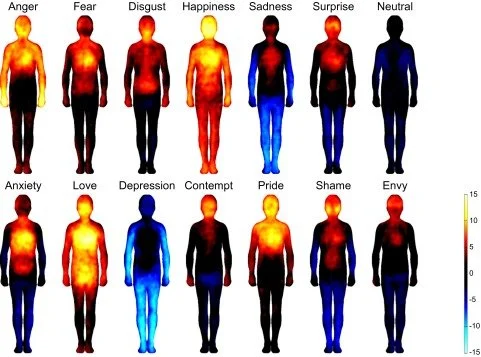
Bodily map of emotions
Most of us also tell ourselves a story about the emotions we notice, and even those we feel, but were never taught the language for. X emotion makes you weak, Y emotion doesn’t matter, etc. This is where somatic therapy shines. Noticing sensations in your body (without judgment!) helps direct your limited mental and emotional energy to processing and soothing intense emotions, instead of fighting them.
Imagine how different it would feel to acknowledge and validate the sadness you feel when you’re misunderstood by your family, or the hurt you feel after being left on ‘read’ in a vulnerable moment. Those feelings are real and impactful.
When Talking Isn't Enough
Now don’t get me wrong, talk therapy is incredibly valuable. Having a space to feel seen, heard, and understood, to organize your thoughts and to reflect without judgment matters. I believe that everyone deserves this kind of space, and somatic therapy is not here to replace it. In fact, a somatic element in counselling is a beautiful addition to traditional talk focused approaches.
Even still, many of us have had this experience:
- you can explain exactly why you're anxious
- you've named the patterns and traced them back to their source
- you’ve analyzed the situation to death
and your body still won't settle
Your shoulders stay tight. Your chest stays heavy. You know you're safe, but you don't feel it. You may not even recognize feeling unsafe as something that can shift.
That gap is often where the body needs care and attention, not more analysis.
What Is Somatic Therapy?
Somatic therapy aims to promote healing and deeper self-understanding by connecting your thoughts, emotions and behaviours with your physical experience. It moves away from viewing mind and body as separate, toward treating them as parts of a unified whole.
It goes beyond asking why you're stressed, anxious, burnt out or overwhelmed. Most of my clients can analyze situations all day long and don’t seek counselling for help on that front. My approach to somatic-focused therapy explores how those experiences show up for you day to day and where your body holds big emotions so we can work together on an approach that brings relief from the bottom up.
The goal of a somatic approach is to become fluent in your body's language and strengthen the communication between your mind and your physical self. In therapy, this looks like really leaning in and recognizing when your body is ‘speaking’ to you through different sensations and noticing when it works to get your attention the most.|
It also looks like learning how to slow down enough to recognize what’s happening and respond directly through regulating tension or distress as it surfaces in the body. For those of us with trauma histories (personally, intergenerationally or both), this process may be more challenging in the early stages and requires extra care.
In practice, this might include:
- grounding exercises
- breathwork
- gentle movement
- body scans
These are always offered as invitations, never requirements. In session, I may also highlight subtle shifts: your hands getting more animated and your pace quickening when you talk about something you love, or your posture collapsing, your voice softening or looking away when a topic feels heavier. These are clues, not judgments, and we always move at a pace that feels good to you.
Why This Matters for Women of Colour
Many of us carry more than we say out loud. The mental and emotional effort of code-switching, microaggressions we're expected to shrug off, the pressure to be the strong one, and cultural messages about which feelings are acceptable to show. Over time, that doesn't just live in our thoughts. It settles into our bodies as tension, fatigue and a nervous system that rarely gets to rest.
Many cultures have always understood this, through movement, breath, music, prayer and touch. Somatic therapy isn't foreign to that wisdom. It's a way of returning to it, in a space where you don't have to explain or justify what you carry. Being understood without having to translate your experience first can be healing on its own, which slowly helps the body (re) learn how to soften.
This part gets personal for me. As the daughter of immigrant parents and a first generation Canadian, the examples set by the women who came before me were heart-wrenching. In my work as a somatic therapist, I am committed to supporting women who are changing their family’s story by writing their own narratives. Therapy with me focuses on empowering you to reclaim your joy, healing old wounds and building a stronger relationship with yourself. A somatic focus allows us to do that in a way that supports you best.
Try It Now: A Quick Body Check-In
Without trying to change anything, take a moment to tune inward and notice how your body feels right now.
What do you notice about your posture?
How's your breathing: deep or shallow, fast or slow?
Is there anywhere you're holding tension?
If it feels right, shake out your hands, wiggle your feet or take one slightly deeper breath. There's no right answer here. Small moments of noticing like this are how reconnecting begins.
Your body has always carried wisdom and the capacity to heal. Sometimes it just needs a little help being heard.
If any of this resonates, I invite you to book a free 20-minute consultation to explore whether my approach is the right fit for you.
Frequently Asked Questions
-
No. It complements it by adding body awareness to the conversation. Talking is still a big part of our sessions.
-
We still talk, but I'll also invite you to notice what's happening in your body, such as your breath, posture and tension. You always have a choice, nothing happens without your consent, and we can slow down or pause whenever you need.
-
Not at all! Many people were never taught the language for what they feel physically. Learning to notice and name sensations is part of the process, and we build it together.
-
It can support people experiencing anxiety, chronic stress, burnout and overwhelm, trauma, and emotional difficulties linked to past experiences. My favourite part is the way it allows us to reconnect with ourselves and cultivate greater self-awareness and self-trust.
-
It can be a good fit if you want care that makes room for your whole experience, including culture, identity and the stress your body carries from navigating systems that weren't built for you.
-
Yes and yes depending on your insurance provider. Please visit my FAQ page for more information!
-
